

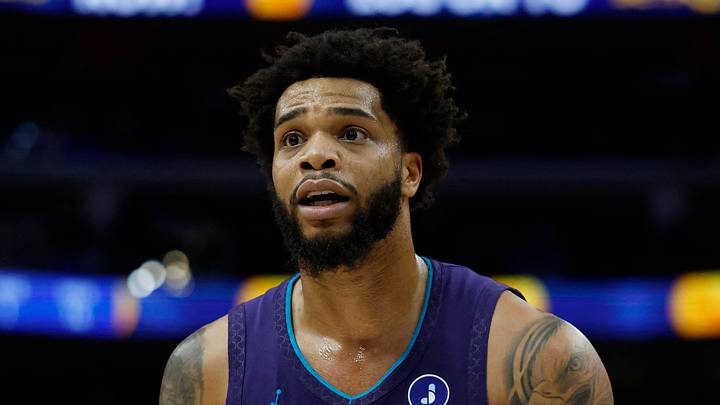
After the Phoenix Suns began the 2026 offseason by snatching up their own free agents to run it back in The Valley, the front office torpedoed the good faith by once again trading an unprotected first round pick (along with Grayson Allen and Royce O’Neale) to acquire Miles Bridges from the Charlotte Hornets. Immediately, questions about a new contract followed, and they won't be going anywhere. After his debut, that's troubling.
The move was lambasted again and again by a variety of NBA pundits, and it continues to look worse after a disastrous 41-point, season-opening loss to Ja Morant and the Portland Trail Blazers.
Portland acquired the former All-Star after Phoenix had already pushed its chips into the middle of the table for Bridges, and the Blazers didn’t need to give up any draft picks to do so. The Suns, in desperate need of point guard depth, probably should have kicked the tires on that high-reward change of scenery. Morant finished with 14 points, eight assists, five rebounds, and three steals in the blowout win.
Instead, the Suns placed a lofty bet on Bridges being able to raise the team’s ceiling—but there remains a very large problem. Bridges is in a contract year and would need to be signed to an extension if his tenure in The Valley extends beyond 2026-27.
What are the Suns going to do about Miles Bridges’ contract situation?
The Suns have been handing out contract extensions in 2026 like suburban homes handing out candy to trick-or-treaters. Dillon Brooks, Collin Gillespie, Mark Williams, Jordan Goodwin, and, most recently, Oso Ighodaro inked new deals to stay in Phoenix long-term.
But what does the future hold for Bridges?
Provided the Suns surrendered yet another unprotected first-round pick (in 2033) along with the aforementioned role players to acquire Bridges, they’re almost forced to keep him around beyond this year.
That same logic applied to Williams, who was retained as a restricted free agent after he himself had been acquired for a first-round draft choice via trade. But the Bridges situation is still entirely different.
First off, Bridges will be 29 years old next summer when his contract is set to expire. Williams, by contrast, won’t even turn 25 until December. The Suns are already in an awkward spot roster construction-wise, leaning heavily on two aging veterans in Devin Booker and Dillon Brooks in a league increasingly shifting toward younger stars.
Second, Bridges has not yet played a full season in Phoenix, as Williams had before being extended. There was certainly an argument to be made for the Suns moving on from Williams. However, he was the team’s leading rebounder a season ago and finished second on the team in win shares behind only D-Book, despite playing just 60 games (which was still a career high).
It’s not worth overreacting to one game, but Bridges’ regular season debut left a lot to be desired.
Miles Bridges’ disastrous season debut only adds to Suns troubles
In 29 minutes of action against Portland, Bridges finished his night with eight points on 3-of-11 shooting (0-of-5 from 3-point range), four rebounds (two of which he grabbed during his final two minutes of playing time in the fourth quarter) and a -35 box plus/minus.
That’s far from the type of production Phoenix expected, considering what they gave up to acquire the Michigan State product.
Again, it’s only one game. Bridges averaged at least 20 points in three of his past four seasons, and he finished in the top 25 in the league in rebounding as recently as 2024-25.
But if Bridges isn’t going to continue his usual production as he gets acclimated to new teammates in Phoenix, the Suns have to consider using the money reserved for a Bridges extension elsewhere—regardless of the haul they gave up to acquire him.
It’s not a good place to be, and it’s still early. But those pontificating that this trade for the Suns was, at best, a lateral move are looking like they were on the mark early on.
 Add us as a preferred source on Google