

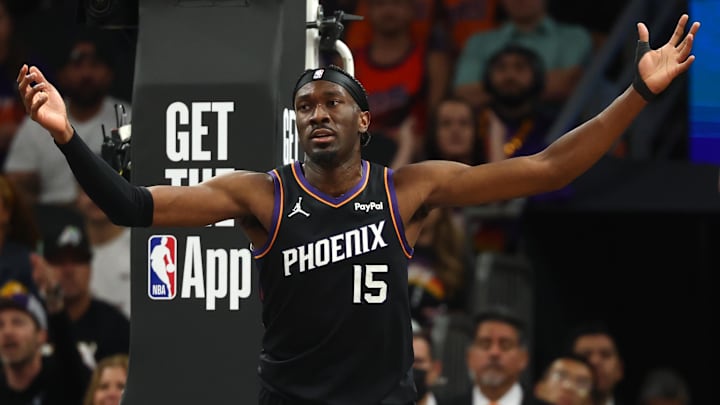
After being swept by the reigning champion Oklahoma City Thunder in the first round of the NBA playoffs, the Phoenix Suns now turn their attention to the offseason and free agency.
A number of Suns players will become free agents, including starting center Mark Williams.
Williams, the 24-year-old acquired last summer from the Charlotte Hornets for a package including multiple first-round picks, will enter restricted free agency. In other words, the Suns will have the “right of first refusal” and can decide to match any offer sheet extended to the big man if they want.
But provided how the season and postseason played out for Williams, the Suns front office should look elsewhere with what limited cap room they’ll have available.
Though Williams is no doubt a talented player at a position of need for the Suns, there’s reason to justify moving on from the former No. 15 overall pick even after surrendering assets to acquire him in the first place.
Mark Williams’ health and availability remain a question mark
Despite the fact that Williams played in a career-high 60 games and more than 1,400 minutes during the regular season for the Suns, his ability to stay healthy has once again been called into question.
After being available for most of the season — albeit while playing just 23.6 minutes per game on average, the lowest since his rookie year — Williams missed nearly the entire month of March with a stress reaction in his left foot.
He returned to the court in April, but the return would be short-lived.
Play-in tournament and postseason combined, Williams played a grand total of 22 minutes. All of those minutes were accrued in the play-in loss against the Portland Trail Blazers, wherein Williams did not play late in the fourth quarter.
It was also rare to see Williams compete in both games of back-to-backs on the schedule, as the Suns opted to preserve Williams’ long-term health.
Unfortunately for Phoenix, even sitting Williams for most back-to-backs and limiting his minutes to averages below what he played in Charlotte didn’t ensure he’d be available come playoff time.
The rival Los Angeles Lakers already vetoed an agreed-upon trade for Williams due to concerns they had from a physical exam. It only took one season for the Suns to see why those concerns appear to be validated.
Mark Williams’ rim protection was the worst of Suns bigs
In today’s NBA, among the most important statistics teams can get from their post players is rim protection and interior defense. It’s why the San Antonio Spurs (Wemby), Minnesota Timberwolves (Rudy Gobert) and Thunder (insert player of choice) are among the top championship contenders in the NBA right now.
But while Williams was a solid option on offense by converting 64.4% of his field goals, his ability to prevent them on the other end left a lot to be desired.
According to stats from NBA.com’s database, Williams’ defended field goal percentage on shot attempts inside of six feet from the basket was 64.4%.
His backup, second-year player Oso Ighodaro, held opponents to 57.8% shooting percentage in those scenarios.
Rookie center Khaman Maluach was even better — holding opponents to 44.3% shooting on those attempts, which was not only the best on the team but also the best in the entire NBA out of guys who played at least 30 games.
For the Suns, only 6-foot-1 guard Collin Gillespie (65.5%) and the traded Nick Richards (69.7%) were less impressive than Williams.
A 7-foot-1 center having defensive metrics similar to that of his 6-foot-1 teammate is a tough look, and a big reason why the Suns should consider moving forward with Ighodaro and Maluach having expanded roles.
Cost to retain Williams could hamper Suns’ depth
What became clear in the four-game sweep against the Thunder is the Suns lack depth on their roster.
Injuries played a big role in that with Williams, Jordan Goodwin and Grayson Allen all sidelined at various points, but Jordan Ott’s second unit in the postseason put way too much pressure on the starters to carry the load.
Provided Gillespie will also be a free agent this summer, though with early Bird rights, the Suns may need to hone in on retaining him at the expense of Williams.
Bringing back both Williams and Gillespie at cost would severely limit what Phoenix is able to do in terms of filling out the rest of the team’s bench.
Williams didn’t show that he can consistently stay healthy or protect the rim. On that basis, moving forward with youth and focusing more on improving the roster’s overall depth may end up being the front office’s best path forward.
 Add us as a preferred source on Google