

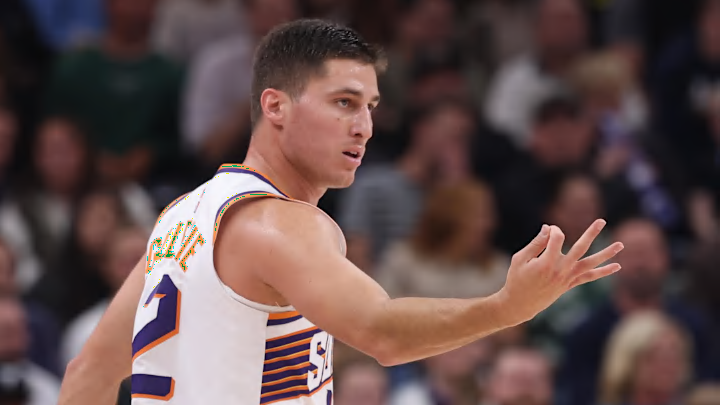
The Phoenix Suns should be feeling good about themselves as they come out of the All-Star break 32-23 and just 1.5 games back of the Minnesota Timberwolves for the sixth seed in the Western Conference.
While the goal now is to finish strong and make the playoffs, general manager Brian Gregory and the Suns front office will have to figure out what to do with the roster this summer. Both breakout point guard Collin Gillespie and center Mark Williams (who was acquired via trade last offseason) will become free agents at season’s end.
Williams is set to become a restricted free agent, meaning the Suns retain the right to match any offer sheet extended to the talented big man in free agency. Of course, that also gives other teams around the league the opportunity to structure a contract that Phoenix won’t or can’t match.
As it stands, the Suns are going to have very limited cap space available this offseason to retain or add players without delving back into luxury tax aprons, but there’s a silver lining as it relates to Gillespie.
Collin Gillespie's early Bird rights may help Suns in free agency
The Villanova product is having a career year by averaging 13.3 points, 4.7 assists, 4.2 rebounds and 1.4 steals per game (all career highs) while sinking a stellar 42.3% of his 3-point attempts. He’s outplayed his one-year, $2.3 million contract by an extremely wide margin and is due for a payday.
But as ESPN NBA front office insider Bobby Marks explained in a recent offseason outlook, Gillespie has early Bird rights. That makes him “eligible to sign a four-year, $66.6 million contract with Phoenix,” per Marks. The Bird rights require any contract be for a minimum of two years (excluding options).
Bright Side of the Sun’s Rod Argent does great work breaking it down, but the long and short of it is “the most a team can offer an Early Bird free agent without using cap space is 175% of his previous salary (up to the max) or 105% of the league-average salary in the previous season, whichever is greater.”
Provided the former figure for Gillespie would be a shade above $4 million, the 105% of league-average salary is far more likely to be where the guard falls in terms of his next salary. That figure equates to around $13.2 million in the first year with annual raises.
As Argent explains, an opposing team could offer Gillespie the full non-taxpayer mid-level exception, which is more than the Suns could offer — but it’s ultimately the difference of $6 million over four years.
That may be enough to lure Gillespie away from The Valley, but he’s expressed his love for Phoenix in the past and may value team fit over raw dollars.
That Bird rights wrinkle may give the Suns more leeway as they look to retain their Most Improved Player candidate.
So, while the offseason looks daunting with two extremely talented players coming off the books, Phoenix’s ability to retain Gillespie actually looks much more feasible from that lens.
Provided the Suns don’t have much other than two-way talent Jamaree Bouyea at the point guard spot, keeping Gillespie long term should be a primary focus of the summer.
 Add us as a preferred source on Google