

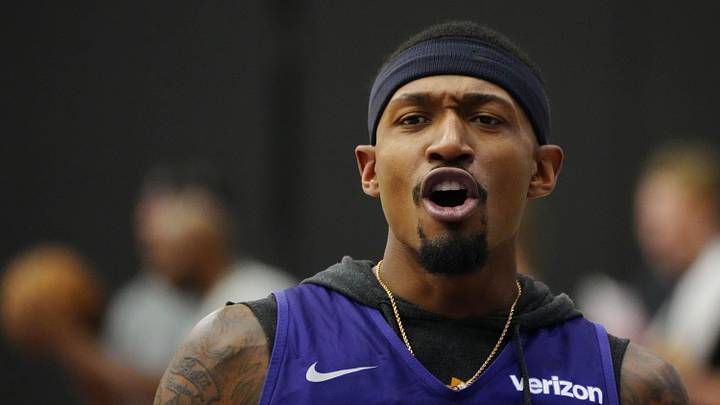
The Bradley Beal era with the Phoenix Suns came and went like a fart in the wind.
After two seasons and 106 games played, his numbers in a Suns uniform didn’t even look bad at all: 17.6 points, 4.3 assists and 3.9 rebounds per game while shooting 50.5% from the field and 40.7% from 3-point range. But the wombo combo of injuries and team fit with Devin Booker and Kevin Durant also on the squad made it an ill-fated trade acquisition from the jump.
Suns fans want to put memories of Beal in the rearview mirror, but the trade that put Phoenix on lists of the NBA’s worst blockbusters and the front office’s subsequent decision to waive and stretch him somehow keeps getting worse for the franchise.
As things currently stand, Beal is going to be the Suns’ fifth-highest paid player next season at roughly $19.3 million. That’s a figure the Suns are set to pay the now 33-year-old guard annually through the 2029-30 season to not play for them, according to data from Spotrac.
Devin Booker, Jalen Green, trade acquisition Miles Bridges and Dillon Brooks will all earn more, but Beal will be paid like a rotational stalwart for the foreseeable future.
Given a recent head-turning blockbuster trade, this big Suns blunder keeps looking worse.
Jaylen Brown trade return should have Suns questioning Brad Beal deal all over again
ESPN’s Shams Charania shocked the NBA community by announcing the Boston Celtics traded All-NBA guard Jaylen Brown to the Philadelphia 76ers for a return of Paul George, two first-round picks and two second-round picks.
George, now 36, is a nine-time All-Star and six-time All-NBA talent in his own right, but he’s played just 78 games combined over his past two seasons. Injuries to his knee and adductor muscle limited his time in Philly and prevented him from making another All-Star team.
Now, George and the roughly $110 million owed to him over the next two seasons is headed to Boston.
The NBA community was stunned by the lackluster return for the Celtics. Suns fans would also be right to question whether Phoenix could have made a more competitive offer for Brown if they hadn’t already pulled the trigger on the trade to land Miles Bridges from Charlotte for Grayson Allen, Royce O’Neale and an unprotected 2033 first-round pick.
That now goes down as another frustrating “what if?” in Suns lore, but it also brings Beal’s contract back to the forefront.
The Suns decided to waive and stretch Beal, hence why they’ll be paying him through the 2029-30 season. ESPN reported at the time that Beal gave back $13.9 million of the roughly $110 million over two years still owed to him, but the Brown-George trade suggests that even the most egregious albatross contracts are not impossible to move.
Beal was injury prone with the Suns (and then suffered a season-ending hip injury with the Los Angeles Clippers after he left), but his stats remained solid despite being held back by a square peg round hole team fit in The Valley.
Of course, there was a key caveat to being able to move him. Beal was one of the few players in league history to have a full no-trade clause in his contract. As CBS Sports reported at the time, the no-trade clause hampered Phoenix’s ability to get in on the Jimmy Butler sweepstakes, as Beal could simply veto any trade he otherwise could have been involved in.
And that, again, raised good questions about why the Suns organization ever decided to trade for Beal in the first place. They had reached the NBA Finals in 2021 with Chris Paul and Devin Booker. They had just added Kevin Durant. Instead of letting that trio of vets see where they could go, the Suns traded CP3 and Landry Shamet (who became a key rotational cog on the New York Knicks 2026 championship team) for Beal and his albatross contract — no-trade clause included.
With the Suns, unforced errors seem to compound on themselves. Trading for Beal was shortsighted enough. Accepting that contract with the full no-trade clause ensured they couldn’t pull off a blockbuster later on like Philadelphia just did.
Truly one of the worst moves in franchise history, and the organization is still (literally) paying for it.
 Add us as a preferred source on Google