

After a 1-5 start to the new season, which includes ranking dead last out of 30 NBA teams in defensive rating, the Phoenix Suns clearly have a lot of problems.
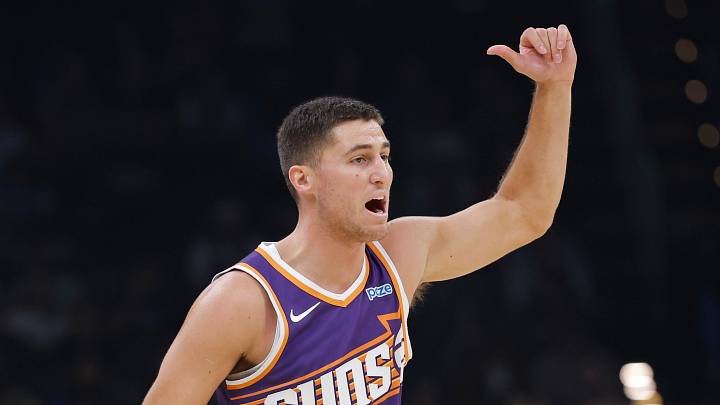
Chiefly, the lack of point guards on the roster, which NBA Insider Chris Haynes reported last month, is leading to growing frustration in the locker room. But the truth of the matter is that the Suns have a capable point guard in Collin Gillespie, who absolutely should be in the starting lineup to help address a lot of the issues we see in the existing starting five.
But while slotting Gillespie in beside Devin Booker in the starting backcourt is a move that makes sense, it doesn’t change the fact that the identity of last year’s surprise Suns team — at least to this point — is gone.
Third Apron Podcast argues Suns’ issues go well beyond point guard
While referencing the report of growing frustration in the locker room from Haynes because Phoenix “does not have a point guard that can organize that offense,” CBS Sports’ Sam Quinn argues that the Suns are wrong to be focused on that one issue.
Quinn rapid-fired a number of on-court, off-court statistics tied to Gillespie this season with the Suns. To list a few from the team’s first six games, the Suns are 6.7 points per 100 possessions worse defensively when Gillespie sits. Their assist percentage of 74 percent with Gillespie on the court is leagues better than the 58.3 percent mark without him out there. Ditto for their steal percentage, which is 12.2 with Gillespie and 5.0 without him. The Suns also score 2.9 more points per 100 possessions when Gillespie is playing vs. when he is not.
“This isn’t rocket science,” Quinn said. “You have a point guard, you’re just not starting him.”
Interestingly, Gillespie hasn’t even played well compared to his breakout campaign a season ago.
Through those six games, the Villanova product is averaging 6.8 points, 4.5 assists and 2.2 rebounds while shooting 31.3 percent from the field and an ugly 25.6 percent from 3-point range. Despite an ice-cold start, he’s still providing Phoenix with enough to make them a better offensive and defensive team when he’s on the court.
That doesn’t reflect well on new addition Miles Bridges and new-ish addition Jalen Green, who’s back healthy after missing most of last season with a recurring hamstring issue.
Bridges-Green combo has ‘robbed the Suns of a lot of their identity’
Quinn argues that beyond not starting Gillespie, the combination of Bridges and Green in the starting five has “robbed the Suns of a lot of their identity.”
He notes that last year the Suns were a great defensive team that finished fifth in deflections (26th this season), sixth in loose-ball recoveries (27th this season), and sixth in offensive rebounding (17th this season).
Quinn argues (correctly) that the defensive acumen and hustle are what defined the Suns’ identity and culture a season ago. Now, there are two new additions to the starting lineup who, largely, were not a part of that success.
“Those guys don’t fit that ethos,” Quinn said.
Quinn’s overarching point and argument is that while there are reports of discontent in the Suns’ locker room over roster construction, those problems go well beyond one position.
Simply put, the 2026-27 Suns are not last year’s team that surprised the NBA landscape by playing harder than everyone else. This year, players are hanging their heads on the court; they’re getting bullied again on the defensive glass, and being without Mark Williams (injury), Grayson Allen (trade), and Royce O’Neale (trade) is hurting them much more than the front office probably realized.
Through six games, the Suns are unquestionably among the four worst teams in the Western Conference — hanging around in the standings with doormats like the Sacramento Kings, Los Angeles Clippers and Utah Jazz. If they don't find their identity - any identity - that's not going to change anytime soon.
 Add us as a preferred source on Google