

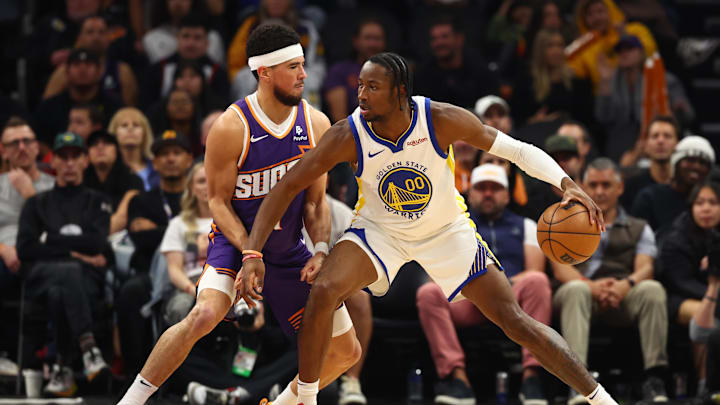
The Phoenix Suns have defied most if not all expectations so far this season.
Despite a hamstring injury that’s kept Jalen Green sidelined; a recent groin strain for face of the franchise Devin Booker; a quad contusion that kept sharpshooting guard Grayson Allen in street clothes for a prolonged stretch and a number of new pieces under a new head coach, Phoenix has a record above .500 into December.
Weathering this gauntlet stretch of schedule without Booker and Green is a new challenge altogether.
Entering a road contest against the Minnesota Timberwolves Monday, Dec. 8, the Suns are 5-6 away from home. That doesn’t bode well for them, provided they’ll have no choice but to be road warriors for at least the next month-plus.
Excluding that game against the T-Wolves, 14 of the Suns’ next 20 games will be on the road. That’s a stretch dating out to Jan. 23 before the Suns return to Mortgage Matchup Center for a five-game home stint.
Regardless of how the Suns fare in that time, the NBA trade deadline will be top of mind for the front office. Scheduled for Feb. 5 at 3 p.m. ET, the deadline to make trades will come up quick after Phoenix finishes out that daunting calendar filled primarily with away games.
So, what will new general manager Brian Gregory and the Suns opt to do?
How the team positions itself in the Western Conference playoff picture over this stretch will no doubt color their outlook, but here’s an early look at Phoenix’s trade deadline options.
Option 1: Suns become sellers at the deadline
It’s no mystery that the Suns’ outlook in terms of draft capital is bleak.
Their future draft picks are extremely convoluted after a smattering of blockbuster trades in recent years to acquire Kevin Durant, Bradley Beal and Mark Williams. But what we know for sure is the Suns don’t outright own their own first-round draft choice until 2032.
Until then, it’s a confusing cocktail of pick swaps where other teams have the right to switch picks with Phoenix if the Suns’ choice is more favorable.
As a result, the Suns are in a position where they should look to acquire draft picks if at all possible.
Players who could already be on the trade block are wings Grayson Allen and Royce O’Neale, along with backup center Nick Richards.
Richards, who is set to become a free agent at season’s end, has fallen out of favor in head coach Jordan Ott’s rotations of late (under 10 minutes played in his last four appearances). He should be a prime candidate to move ahead of the deadline.
He’s a nice depth piece for Phoenix to have — especially since Williams isn’t logging huge minutes and misses the occasional contest for load management. However, as an expiring contract who’d likely get to play more in a different situation, the Suns could be inclined to deal Richards.
Perhaps that would happen as a package deal with Allen or O’Neale. Both guys are controllable assets under contract for at least next season. Allen has a player option for 2027-28, whereas O’Neale becomes an unrestricted free agent after that season.
They've both been awesome for the Suns so far, showing off their 3-point prowess while playing their roles extremely well around Booker.
Their career-best play could provide incentive for the Suns to sell high via trades, potentially getting draft pick(s) in return from a contender looking to load up for the postseason.
Option 2: Buy and sell
If the Suns are in the playoff conversation and want to tinker with the roster ahead of the deadline, a mix of selling and buying could be an intriguing albeit challenging route to consider.
Taking yet another big swing to trade for someone like Memphis Grizzlies point guard Ja Morant seems farfetched, for a few reasons. Again, the Suns don’t possess the draft assets likely required to pull off such a deal. Also, the vibes and culture shift under Jordan Ott is not something the franchise should jeopardize for a malcontent like Morant who may not fit in that regard.
What the Suns could opt to do is toe the line for a player who could be an immediate upgrade while not compromising long-term salary cap flexibility.
Enter Atlanta Hawks point guard Trae Young, who may not command a slew of draft picks given his contract and health (he's missed all but five games this season due to a knee injury). Young has a player option for next season worth roughly $49 million if he opts to exercise it. Otherwise, he could opt out and become a free agent at season’s end.
Either way, getting that type of money off the books either this summer or during the 2027 offseason could be an appealing draw for the Suns’ front office. Financial flexibility would again make them an appealing free-agent destination for big names looking to play alongside Book and Co.
If the Hawks — who are 12-8 without Young this season — think moving forward with Jalen Johnson as their star is the best path forward, Young could be dealt.
Matching salaries to acquire someone like Young at ~$46M is where things get complicated. Atlanta could throw cash considerations into a deal to offset that salary, but there are limits on that imposed by the league. Being able to add enough outgoing salary for this type of deal would likely handcuff the Suns.
Jonathan Kuminga of the Golden State Warriors is another name being floated often in NBA trade rumors.
His salary of $22.5 million this season is more trade-friendly compared to Young, and he has a club option for next season as well.
Kuminga has a trade restriction until the middle of January, so there’s time for both sides now to at least work on a framework of a possible deal to benefit both Pacific Division rivals. Perhaps a multi-team trade could ultimately allow the Suns to acquire Kuminga as a means of retooling the roster without being fully committed sellers.
Option 3: Stand pat
The Suns have yet to experience a fully-healthy roster this season. In spite of that, they’re winning games and beating expectations. So, do the Suns even need to make a deal ahead of the deadline?
Conventional wisdom suggests Gregory and the Suns can’t limit their options. They should be listening to every offer, every phone call.
But while that should be the case, the Suns don’t necessarily need to make changes. We don’t really know what this team will ultimately look like with Booker and Green both healthy and contributing.
Green’s return can be treated like an in-season acquisition without having to surrender assets.
If Phoenix gets hot and plays well upon Green’s return to the court, the front office may simply continue to see what they have with the pieces in-house and re-evaluate during the offseason.
Option 4: Blow it up
Provided how well the Suns have played this season relative to expectations, this option feels increasingly unlikely.
Booker continues to hint that he’d prefer to stay in Phoenix for the entirety of his career. The Suns brass owe it to Booker to reward that loyalty by trying to build a contender around him in what prime years he has left.
But if things go really sour over the next two months, maybe Gregory would look to recoup a haul of draft picks by trading Book to the highest bidder.
Again, this feels very unlikely. The Suns are playing well and providing a fun product for fans to watch — even if they won’t be championship contenders.
For “blow it up” to be an even semi-reasonable option, we’d first need to see a 180 flip from Booker demanding a trade.
 Add us as a preferred source on Google