

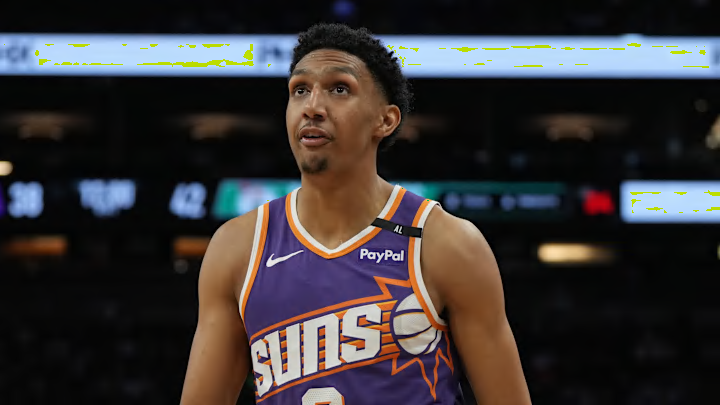
With the rise of Rasheer Fleming and glut of veteran wings on the roster, Ryan Dunn is beginning to lose ground in the Suns' rotation. That's not great news, considering Dunn seemed to be a pivotal piece of the 2025-26 Suns in his sophomore season, a key developmental year for him.
The problem is that development never really came. Dunn is still an athletic, disruptive defensive wing, but the flaws remain on the offensive side of the ball. His shooting stats are almost identical to his rookie season: field goal percentage improved from 43.0 to 43.3, 3-point percentage went up from 31.1 to 32.4 (on 1.1 fewer attempts per game), and free throw percentage improved from 48.7 to 50.0. Minimal improvements in key areas of his game that remain extremely exploitable.
Ryan Dunn's minutes are on the decline
With all the talent rising behind him in the depth chart, it was only a matter of time before players on this deep Suns roster begin to take his minutes. None of them may be as exceptional on defense, but they also don't have his exploitable offensive flaws.
Dunn played just 10 minutes against Charlotte on Sunday, the fewest minutes he's played in a game since early February. His minutes per game have been on the decline since November, from 24.4 to just 15.7 minutes each night so far in March.
His biggest threat to minutes: rookie Rasheer Fleming
After spending most of the season with the Valley Suns, we are now in the midst of a breakout for rookie Rasheer Fleming. Capped off by a career-high 16 points on 100 true shooting percentage (including making four of six from 3) against Charlotte, his minutes continue to rise, and he already appears to be a key role player on this team. Over the last four games, he's averaging more minutes per game (15.8) than Dunn (15.7), and that gap grows even wider in each contest.
In comparison to Ryan Dunn, Rasheer Fleming already looks like the more valuable player. Fleming is taller (6'9 v. 6'7) and longer (7'5 wingspan v. 7'2), and Fleming has proven to be a better shooter, making 50.0 percent from 3-point range on his last 32 attempts.
Roles reserved for the vets
It isn't just Rasheer Fleming that's taking his minutes. This is a Suns squad with remarkable depth. For starters, the starters: Dillon Brooks (who's set to return from injury in the coming weeks) and Royce O'Neale, two veteran leaders who have been fundamental to the team's success this season.
Although currently injured, another key role player has been Jordan Goodwin. A surprisingly impactful player this season, he epitomizes the heart and grit this team is all about. That alone demands playing time (not to mention the relentless perimeter defense and solid shooting numbers).
Remaining roster depth demands playing time
Beyond that, the midseason roster additions also appear worthy of some playing time. Amir Coffey hasn't gotten a ton of run since landing in Phoenix at the trade deadline, but he's given the Suns good minutes whenever his name has been called, averaging 5.1 points on 59.7 true shooting percentage in 15 minutes per game across ten contests.
And they added another guy to the mix with the signing of Haywood Highsmith, who recently made his debut and looks to be another player deserving of a role. In (basically) his first game as a Sun, he was a +19 in 21 minutes and helped the Suns secure a much-needed win over Charlotte.
Now, that's a lot of players in contention for playing time, all looking to play the same role as Ryan Dunn. It'll be hard to justify Dunn's minutes with the breadth of options at Coach Ott's disposal.
 Add us as a preferred source on Google