

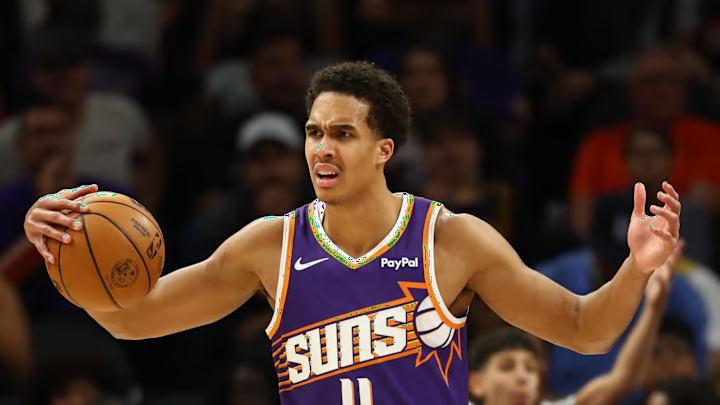
There’s been no sophomore slump from Phoenix Suns big man Oso Ighodaro. Despite a head coaching change and roster turnover via the Kevin Durant trade, Ighodaro maintained a spot in the Suns’ rotations under first-year head coach Jordan Ott.
His early-season allotment was very similar to his 17.1 minutes per game as a rookie, but as the season winds down, he’s now notching 22.2 minutes per contest, in part due to trust from the coaching staff and in part because Mark Williams is sidelined with injury.
Ighodaro’s statistical improvement hasn’t been huge, but he’s averaging career highs with 6.6 points, 5.0 rebounds, 2.3 assists, 0.9 steals, and 0.6 blocks per game while shooting a career-best 65.2 percent from the floor.
The Arizona native has been a steady and reliable presence for Ott, holding down the backup center spot with great defense and an improving basketball IQ on offense.
There are pieces of Ighodaro’s game he still must improve, but the second-year player is carving out a niche with his hometown team.
The Good: Oso Ighodaro’s rim protection and interior defense
Ighodaro still has plenty of improvement he can make on offense, but his defensive impact in just his second year as a pro is standing out.
Suns opponents have an offensive rating of 112.5 points per 100 possessions when Ighodaro is on the court. When he sits, that number grows to 115.4.
Oso acting as a deterrent on the interior is a big reason why opponents aren’t as efficient on offense when he’s playing. According to NBA.com data, Ighodaro’s defensive field goal percentage of 58.3 percent on shot attempts within six feet of the basket ranks him tied for 32nd in the entire NBA (when filtering for players who’ve played at least 30 games and defend at least four such shots per contest).
For context, Oso’s teammate and Suns starting center Mark Williams surrenders a shooting percentage of 65.4 percent in such scenarios. That ranks him 94th among that same crop of players, and behind much shorter Suns teammates Collin Gillespie and Royce O’Neale.
But Ighodaro isn’t a one-trick pony with defensive output.
While he’s not a polished offensive player and doesn’t have much of a jump shot to speak of, the Suns’ offensive rating of 118.3 points per 100 possessions when he plays is vastly better than the 114 mark when he sits.
Defense leads to offense, as they say, and Ighodaro’s impact on both ends results in a net rating of plus-7.1 points per 100 possessions from an on-court/off-court perspective. The Suns are, without argument, a better basketball team when Ighodaro has been on the floor throughout his sophomore campaign.
The Bad: Lack of offensive versatility
In a league that’s increasingly putting emphasis on players who can spread the floor 1-5 by shooting 3s, Ighodaro is in the old-school center mold. He’s attempted just one 3-pointer all season, bringing his career total of attempts from beyond the arc in the NBA to three.
Now, that’s not necessarily a bad thing. As we’ve already noted, the Suns are a much better offensive and defensive team when Ighodaro is playing, so it’s not like he’s hindering the offense overall.
A third of Oso’s field goal attempts this season have been dunks, and he’s shooting 80.1 percent on field goals within three feet of the basket. That’s surprisingly one of the rare statistical instances where he’s been less efficient than he was as a rookie. His shooting percentage of 47.1 percent on shots from 10-16 feet is far from lackluster, but those attempts are occurring just 10 percent of the time.
For now, Oso can happily defer to score-first teammates in Devin Booker, Jalen Green and Dillon Brooks. It’s a formula that’s worked consistently within the Suns’ offense this season, but as Ighodaro continues to develop his game, being able to provide more than lob finishes and attempts at the basket could bring another dynamic opposing defenders have to be cognizant of in the years to come.
The Ugly: Oso Ighodaro’s free throw shooting remains a wart on his game
Ighodaro’s impact in year two has been largely positive. He’s aiding the offense through screening and finishes at the basket, while his defense thwarts attempts on the interior as a defensive anchor. But opposing teams are catching on to Ighodaro’s biggest weakness: free throw shooting.
As a rookie, Ighodaro was sent to the charity stripe 50 times and cashed in on only 58 percent of those attempts. It’s only gotten worse in his second year.
At the time of writing, Ighodaro’s been sent to the free throw line 111 times this season, more than double he saw as a rook, and he’s shooting a woeful 45.9 percent on those attempts.
For added context, the league’s worst-qualified free-throw shooter is Giannis Antetokounmpo, whose 65 percent shooting from the free-throw line looks downright sterling compared to Oso’s ghastly figure.
With free throw shooting that poor, Ott has little choice but to sit Ighodaro late in close games. That’s not a quality you want in someone who has otherwise shown to be a huge net positive for the product on the court.
If Ighodaro aims to improve any aspect of his game heading toward year three, let it be his free-throw shooting. At this stage, a swap to granny style a la NBA great Rick Barry would help him.
The Suns have a huge decision to make this offseason when Williams becomes a free agent. With Gillespie also needing a new contract, perhaps the Suns’ brass will focus on bringing back their breakout guard and letting Williams (and his questionable health history) walk this summer.
If that winds up being the case, it’ll show massive trust in Ighodaro to hold down the interior in The Valley. That type of endorsement would certainly show how the front office views Ighodaro’s development both now and into the future.
 Add us as a preferred source on Google