

The Phoenix Suns are a proud NBA franchise.
Debuting in 1968-69, the Suns boast the fifth-best regular season winning percentage all-time behind only the Boston Celtics, San Antonio Spurs, Los Angeles Lakers and Oklahoma City Thunder.
A number of star players have made their way to the desert in that time, including a few who established themselves as perennial All-Stars early in their career but didn’t make it to Phoenix until they were older when their skills and athleticism were dwindling.
Chris Paul, who was unceremoniously let go from the Los Angeles Clippers during his farewell tour this year, is a solid example.
The “Point God” was still near the top of his game in November 2020 when he was acquired from OKC via trade. That being said, he was also in his mid-30s after showcasing a Hall of Fame quality career with New Orleans, LA and Houston before making it to The Valley.
Paul is the most recent example of an all-time great who played for the Suns later in his career. Players who established themselves as faces of the league with other teams before making their way to Phoenix. That’s who we’re focused on here.
We’re taking a look at those guys as we build the Phoenix Suns All-Twilight team.
Here’s who makes the cut:
Chris Paul, point guard
CP3 was already a 10-time All-Star when the Suns acquired him starting with his age 35 season.
Paul was still a huge difference maker at the time as a floor general. He helped guide Phoenix to its first NBA Finals appearance since 1993 with Charles Barkley (who they also acquired via trade) in 2021.
He made two more All-Star teams as well as the All-NBA Second and All-NBA Third Team during his brief tenure with Phoenix.
His true decline took hold after he was shipped to the Washington Wizards in the ill-fated Bradley Beal trade.
Now aged 40, Paul’s time in the NBA might have reached an end, but the Suns managed to get the best that CP3 had left on the wrong side of 30.
Anfernee "Penny" Hardaway, shooting guard
A former No. 3 overall draft pick, Penny Hardaway established himself as a burgeoning star early in his career with the Orlando Magic.
He made his way to Phoenix at age 28, which doesn’t exactly qualify as “twilight years” even for a professional athlete. The circumstances surrounding Hardaway, however, were different.
The Memphis product was trending to become an all-time great. A 6-foot-7 point guard/shooting guard hybrid, Hardaway was ahead of his time in terms of size matched with elite skill. But injuries derailed Hardaway’s career.
Hardaway suffered a knee injury during the 1996 playoffs against the Detroit Pistons following a collision with Joe Dumars. Hardaway subsequently underwent microfracture surgery, a relatively new procedure at the time, and later called it “the worst decision I had made in my life.”
Hardaway said he was never the same after the injury and dealt with constant pain.
After joining the Suns to form “Backcourt 2000” with Jason Kidd in Phoenix, Hardaway said he’d continually get cortisone shots in his knee to be able to play. “Mentally I was gone,” he said. “I was like, ‘How can I overcome these knee injuries?’”
In an interview with Mike Philbrick of Grantland, renowned sports medicine Dr. James Andrews described Hardaway’s specific injury as follows:
“He had an articular cartilage injury, an injury to the smooth lining of the joint that allows the gliding of the joint. Back then we didn’t really have MRIs to make the diagnosis. Today? Now you would see that on an MRI. It’s still a nemesis and the hardest thing in treatment because the body doesn’t have a way to regenerate it.”
Hardaway’s knee injuries are still among the biggest “what ifs” in NBA history. We can only wonder what he would have accomplished had he stayed healthy. He never made another All-Star team after leaving Orlando and played parts of five seasons in Phoenix.
Grant Hill and Vince Carter, small forward
Grant Hill — another former Orlando Magic player who established himself as a star right away with the Detroit Pistons by winning Rookie of the Year, making five All-Star teams and earning multiple All-NBA nods — joins Hardaway on the squad.
Like Paul, Hill didn’t make his way to the Valley until his age 35 season. He’d undergone multiple surgeries for left ankle injuries in his career to that point, one that even led to a life-threatening MRSA staph infection.
But Hill’s time in Phoenix is remembered more fondly than that of Hardaway. A wily veteran at the time, Hill established himself as a key role player alongside Steve Nash.
Despite the injury history, Hill played in at least 80 games in three of his five seasons in Phoenix.
As a Sun, Hill averaged 12.1 points, 4.7 rebounds and 2.5 assists per game while making 49% of his field goals and 35.4% of his 3-point tries.
Not exactly the All-NBA talent he was in Detroit, but those are still some solid twilight years from a class act who was a net positive in the Phoenix locker room.
Honorable mention is also in store here for Vince Carter. Arguably the greatest dunker in NBA history, VC was traded to the Suns during the 2010-11 season from the Orlando Magic at age 34 in a six-player swap.
Carter was waived by the Suns less than a year later. He was long removed from his eight All-Star appearances by the time he made it to the desert, but he did earn Sixth Man of the Year votes in Dallas and Memphis after he left.
Maurice Lucas, power forward
Maurice Lucas was the leading scorer on the 1976-77 Portland Trail Blazers team who won an NBA championship with Bill Walton.
Before he made it to the Suns at age 30, Lucas had earned four All-Star nods, two All-Defense teams and an All-NBA Second Team selection to accompany his championship ring.
Lucas earned his fifth and final All-Star selection during his first season with the Suns when he averaged 16.5 points, 10.4 rebounds and 2.8 assists per contest.
All told, Lucas played three seasons in Phoenix before bouncing around during his final three pro seasons with the Los Angeles Lakers, Seattle SuperSonics and Trail Blazers, respectively.
Shaquille O’Neal, center
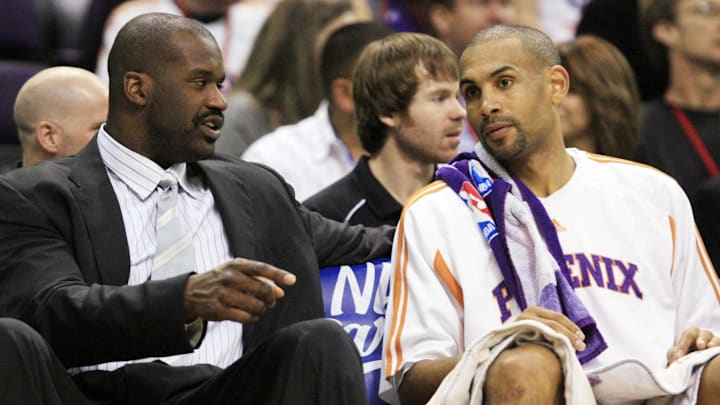
“The Big Cactus” or “Shaqtus” as “The Big Aristotle” wanted to be known in The Valley, the Big Fella was no longer the dominant basketball force of nature by the time he played for the Suns.
Shaq brought promises of a ring to Phoenix after former general manager Steve Kerr traded Marcus Banks and beloved (but disgruntled) forward Shawn Marion to the Miami Heat to acquire him. Like others before him on this list, he was acquired at age 35.
Kerr famously, or infamously, said after the fact, “If it works, I’m a genius. If it doesn’t, I’m a moron.”
“Moron” is probably too strong, but it’s fair to say the O’Neal acquisition didn’t pan out in the desert.
Steve Nash had to adjust his breakneck pace and general style to accommodate for O’Neal’s post-up opportunities. He did so with aplomb, as a then-36-year-old Shaq made his final All-Star team and All-NBA Third Team in 2008-09 while averaging 17.8 points, 8.4 rebounds and 1.7 assists per game while leading the league in field goal percentage at 60.9%.
Despite that individual success, though, the Suns as a team struggled under new head coach Terry Porter, who was fired and replaced by Alvin Gentry mid-season. Phoenix failed to even reach the playoffs with Shaq and Nash in tow that year.
Shaq was traded that summer to the Cleveland Cavaliers as Kerr’s experiment failed to pay off.
 Add us as a preferred source on Google